Can it understand you? The first 5,000 characters
Reading is not the same as understanding. A model that opens your homepage works from the text it meets first. If that text is a menu, a cookie banner and a slogan, the model has to guess what you sell.
What the model actually saw
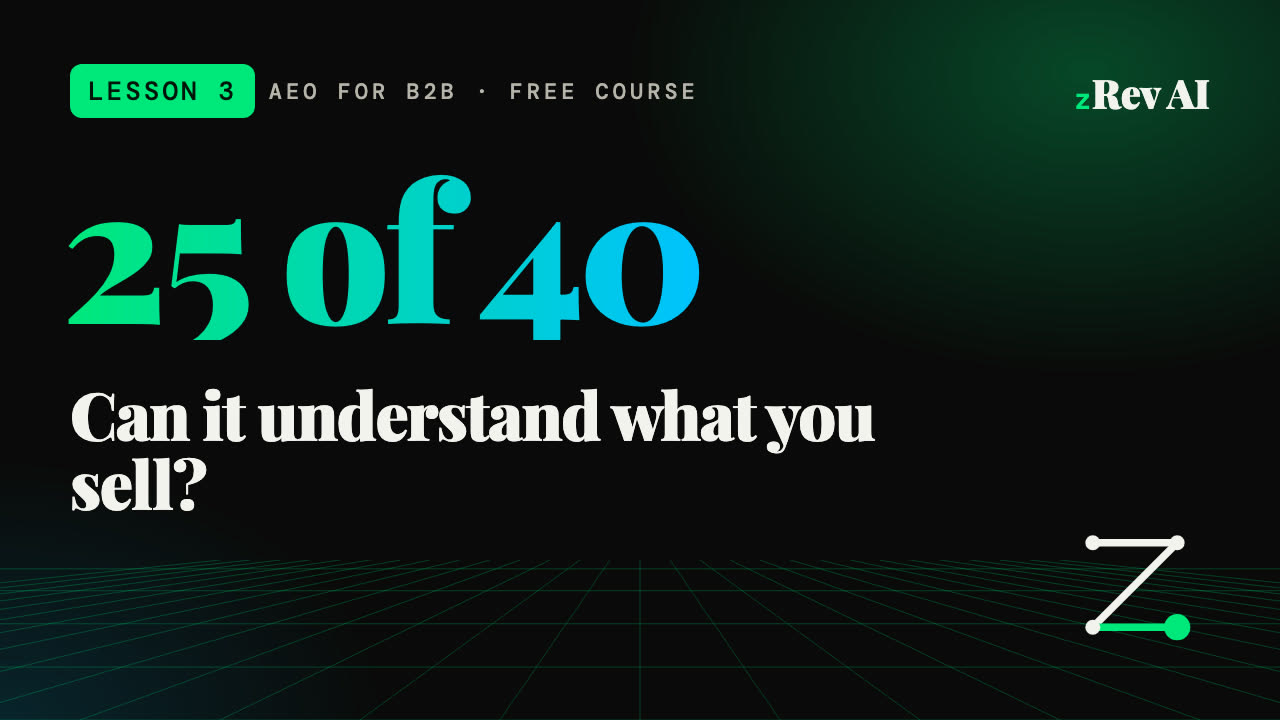
In our study we gave a language model the first 5,000 characters of 40 B2B software homepages and asked it what each company does. 35 said plainly what the product does and 31 showed some proof: a number, a type of customer, a ranking. Only 25 named who the product is for.
In 12 of the 40, the first 5,000 characters were mostly navigation menus or code. Nine homepages showed no proof at all, and eight of those nine were the noisy ones. The proof was on the page. The reader never reached it.
Three things in the first screen of text
What it is, in the category words a buyer would type, not a metaphor. Who it is for: the role, the kind and size of company, the industry if you serve one. Why to believe it: one concrete proof point, such as the kind of companies that use it or a result you can stand behind.
A useful pattern is one plain sentence near the top: [Company] is [category] for [audience] that [outcome]. It does not replace your headline. It sits beside it, in the HTML, where a model meets it early.
Order in the HTML, not only in the design
A model reads the source in order. Mega-menus with hundreds of links, long cookie notices and inline scripts can all come before your first sentence. Keep the navigation lean, keep scripts in files rather than inline, and make sure the hero text appears early in the source, not only early on the screen.
Write sentences that can be quoted
An assistant quotes or paraphrases. Give it sentences that stand on their own. "Work, reimagined" cannot be quoted usefully; "a lead routing tool for B2B sales teams on Salesforce" can. The same applies to your product, pricing, integrations and comparison pages: say the plain thing once, early, in words a buyer uses.
Pages that answer the questions buyers actually ask, one question per page, give assistants something exact to cite. That is why short answer pages work well in AEO.
Open View Source on your homepage, copy the first 5,000 characters of visible text, and give them to an assistant with this prompt: "Using only this text, what does this company sell, to whom, and what evidence is there that it works?" If the answer is vague, so is your page to every assistant.
Check yourself
0 / 3In our cold read of 40 homepages, why did most of the sites without visible proof miss it?
Eight of the nine with no proof were the noisy ones: the proof existed further down the page.
Which opening gives a model the most to work with?
It states the category, the audience and the platform in words a buyer would use.
Which of these did the fewest homepages state plainly?
Only 25 of 40 named who the product is for, the least common of the three.